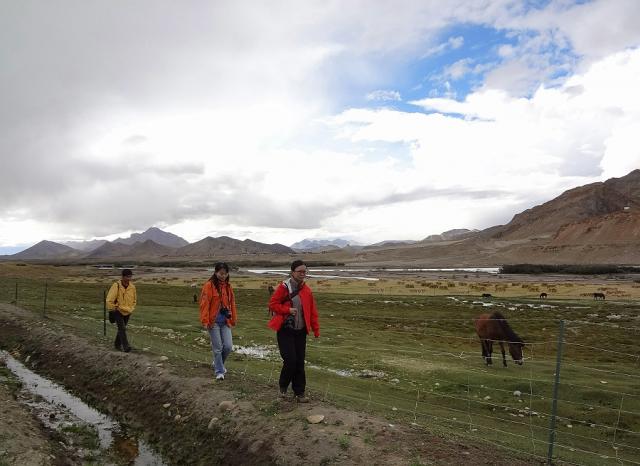
On October 8, 2011, our second project of Vale Award was launched in Nyalam County’s Daqu Village. Led by Mr. Nanchu Ouzhu, Daqu’s Village Chief and other village leaders, over 120 village members participated in the construction of the project, which is expected to be completed by the middle of the month.
The project, by setting enclosures around the village’s farmland, aims to protect over 70 hectares’ farmland from being trodden by wandering animals like cattle, houses and sheep and reduce collateral agricultural lost. The protected farmland will ensure increased agricultural productivity and safeguard food security for low income villagers in the community. In the meantime, as a main feed for livestock, the leftover of harvested Tibetan barley will also increase, which reduces traditional dependence on natural grassland and stimulates the sustainable development for animal husbandry in the region. It will benefit over 500 villagers and more than 8000 livestock in Daqu Village.
 On the other hand, traditional enclosures of the village’s farmland are made of earth blocks dug from the neighboring wetland, which also brings about expansive destruction to ecosystems of wetland and grassland where uprooted grasslands cannot be easily recovered at this altitude of 4300 meters high. By using wire enclosures, it will therefore end such unsustainable and environmentally unfriendly activities, and leave time and space for destructed wetland to restore, where conservation can be achieved for animals living on such natural resource.
The Pendeba Society would like to express our sincere gratitude to Vale Award and the Government of Nailong Township, who provide funding and other support to make this project run smoothly. We also like to thank Daqu villagers because without their active participation and involvement, this project cannot be implemented this early. By the end of the project, follow-up lectures will then delivered to Daqu community on environmental conservation and community development.
This is just a beginning of our conservation effort. In the near future, The Pendeba Society will apply various approaches such as traditional sheep corral transformation to better conserve the wetland and grassland that exist along Pengqu River, the largest river in QNNP.

 In the ceremony of Ford Green Awards 2011 held in Beijing on December 2nd, The Pendeba Society was awarded with the top prize of Nature Conservation Pioneer Award for its Nature Conservation and Community Development Project and 200,000 yuan as the project fund. Mr. Tsering Norbu, Director of The Pendeba Society accepted the award on behalf of this project. Mr. Joe Hinrichs, President, Asia Pacific and Africa Ford Motor Company and Chairman and CEO, Ford Motor (China) Ltd., who described the Pendeba Project as respectful, awarded Tsering Norbu with the certificate and trophy. Along with The Pendeba Society, another 29 excellent individual environmentalists and civil environmental organizations were also awarded with Ford Green Awards prizes.


 On October 18, 2011, our forth project of Vale Award was launched in Tingri County’s Enba Village. Led by Mr. Sonam Tsering, the village chief, over 160 village members participated in the project, which is expected to be completed by the end of the month.


 Furthermore, a workshop on environmental conservation and windbreak services will also be conducted later after the completion of the project by Mr. Soulun, an experienced conservationist who has been working in QNNP for the past 18 years. The Pendeba Society would like to express our cordial gratitude to Mr. Suolun for his generous support and help on this project and we wish to deepen our cooperation and partnership in the near future, which we believe will surely bring concrete benefits to the conservation and stimulate community development in Tingkey County.
 On October 6, 2011, Mr. Norbu delivered a workshop to 50 project participants of Chuxi Village focusing on public healthcare, wetland management, environmental conservation in QNNP and on-going projects of The Pendeba Society. The event also marked the successful completion of the Society’s Chuxi Wetland Conservation Project funded by Vale Award.
  Mr. Basang, Chuxi Village Chief on behalf of the village expressed gratitude to The Pendeba Society for the project and hopes that more projects of such will be carried out in his village in the near future. The Pendeba Society is also appreciative of Chuxi community for their active participation and contribution to this project, without which it cannot be a success. After the workshop, a project assessment was also conducted where we gathered valuable information about the community’s attitudes toward our project and their need, which will be of great help to planning our future projects for the community.